
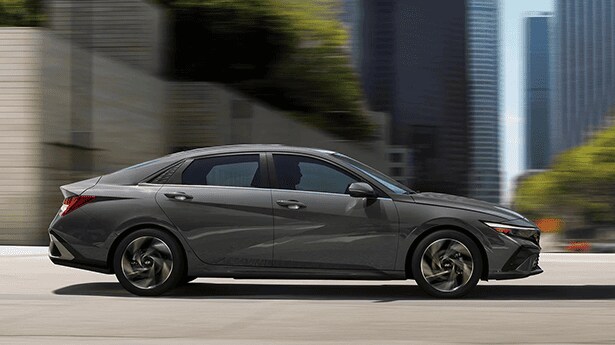
For daily commuters driving along the I-270 outer belt toward downtown Columbus, fuel economy plays a central role in managing vehicle operating costs. The 2026 Hyundai Elantra Hybrid provides two distinct efficiency tiers across its model lineup. The efficiency leader is the Blue trim, which leverages lighter curb weight and specialized low-rolling-resistance tires to deliver 58 mpg highway. Independent testing by Edmunds recorded 55 mpg on a real-world evaluation loop, proving that Hyundai's engineering translates directly to highway performance.
The 2026 Hyundai Elantra Hybrid Blue achieves an EPA-estimated 51 mpg city, 58 mpg highway, and 54 mpg combined, while driving up to 594 miles on a single 11-gallon tank of regular gasoline. The SEL Sport, SEL Sport Plus, and Limited trims deliver an EPA-estimated 49 mpg city, 52 mpg highway, and 50 mpg combined. Total real-world efficiency depends on driving habits, terrain, ambient temperature, and wheel sizing.
Even on higher-tier models such as the Limited trim, which Car and Driver measured at 41 mpg during a sustained 75-mph highway evaluation test, fuel consumption remains exceptionally low compared to standard gas-powered compact sedans. The hybrid system delivers 195 lb-ft of combined torque, offering prompt throttle response when merging onto highway ramps or passing slower traffic.
Every sedan comes backed by America's Best Warranty, including a 10-Year/100,000-Mile Powertrain Limited Warranty and a 10-Year/100,000-Mile Hybrid Battery Warranty. To explore current availability or plan your visit, drivers can find directions to our Dublin area showroom or give our sales team a quick call today.
Does the 2026 Elantra Hybrid Require Plug-In Charging and How Does Its Battery Work?
The 2026 Hyundai Elantra Hybrid is a self-charging conventional hybrid that never requires plug-in charging or external electrical infrastructure. The vehicle automatically recharges its 1.32 kWh lithium-ion polymer battery while driving using regenerative braking and power generated by the internal combustion engine.
The hybrid architecture integrates a 1.6-liter GDI four-cylinder gasoline engine producing 104 horsepower with a 32 kW electric motor that adds 43 horsepower. Together, the system outputs 139 combined horsepower. Rather than relying on heavy high-voltage plug-in hardware, this self-charging setup operates dynamically in the background. The internal management unit evaluates vehicle speed, battery state-of-charge, and pedal force to automatically switch between electric-only mode, gasoline power, or a combination of both.
By positioning the 240-volt lithium-ion polymer battery directly underneath the rear passenger seats, Hyundai engineers preserved standard interior dimensions. Drivers get full utility with 42 inches of front legroom, 38 inches of rear legroom, and a full 14 cubic feet of trunk cargo volume without losing space to battery packaging.
Shoppers interested in comparing electrified powertrains alongside pre-owned choices can explore our pre-owned vehicle selection online to evaluate efficiency across model years.
How Do Regenerative Braking and Smart Drive Mode Maximize Real-World MPG?
Regenerative braking captures kinetic energy during deceleration and converts it into electrical energy to recharge the hybrid battery, directly expanding electric-only driving duration and reducing gasoline consumption. Combining driver-controlled braking modulation with Smart Drive Mode enables the powertrain to automatically balance power output and fuel conservation based on real-time driving habits.
When the driver lifts off the accelerator or applies gentle pressure to the brake pedal, the electric motor reverses its operation, acting as a generator. Instead of wasting kinetic energy as friction heat through the brake pads, the system feeds electric current back into the 1.32 kWh battery pack. Coasting down mild gradients or gradually slowing for traffic lights maximizes energy recovery, allowing the vehicle to run in electric-only EV mode more frequently during city traffic.
The selectable Drive Mode Select system allows drivers to tailor vehicle dynamics:
- Eco Mode: Maps accelerator input for maximum energy savings, shortens climate control duty cycles, and optimizes engine shutoff timing.
- Sport Mode: Holds lower gear ratios in the dual-clutch gearbox and sharpens throttle response for dynamic acceleration.
- Smart Mode: Continuously monitors throttle velocity, steering inputs, and road incline to switch between Eco, Normal, and Sport algorithms.
Our sales team frequently walks commuters through these settings during test drives near the Scioto River parkway corridor, demonstrating how Smart Mode automatically returns to maximum efficiency once cruising speeds stabilize on open pavement.
Shoppers looking for certified quality with complete warranty coverage can browse our certified pre-owned inventory to see late-model hybrid sedans equipped with advanced drive modes.
Why Does the Elantra Hybrid Use a Dual-Clutch Transmission Instead of a CVT?
Hyundai equips the 2026 Elantra Hybrid with a 6-speed EcoShift dual-clutch automatic transmission to eliminate the engine droning and rubber-band throttle feel associated with continuously variable transmissions (CVTs). This transmission uses mechanical gears and dual clutches to deliver direct power transfer, crisp shifts, and natural acceleration response while maintaining high fuel efficiency.
Most competing hybrid sedans utilize planetary gear CVTs that cause the gas engine to rev at high RPMs under load. By contrast, the 6-speed dual-clutch transmission pairs directly with the electric motor to supply immediate low-end pull. The electric motor contributes 125 lb-ft of torque right off line, while the combined system yields 195 lb-ft of combined torque.
The dual-clutch mechanism pre-selects the next gear ratio for rapid gear engagement, minimizing power interruption during acceleration. This mechanical efficiency reduces energy loss inside the gearbox, directly supporting the Blue trim's 58 mpg highway rating while giving drivers a familiar, connected gear-shifting experience when merging onto high-speed roadways.
If you are planning to upgrade from your current vehicle, our online valuation tool allows you to value your trade-in online in minutes to see how your vehicle's equity can apply toward a new hybrid purchase.
Why Does the Elantra Hybrid Blue Trim Get Higher MPG Than Other Trims?
The 2026 Hyundai Elantra Hybrid Blue delivers an EPA-estimated 54 mpg combined, outperforming the SEL Sport, SEL Sport Plus, and Limited trims—which achieve 50 mpg combined—because it carries less total vehicle curb weight and features smaller wheels engineered for low rolling resistance.
Rotational mass and aerodynamic drag significantly affect fuel consumption. The entry-level Blue trim comes fitted with 16-inch alloy wheels wrapped in 205/55 R16 tires. These smaller assemblies feature a narrower contact patch and lighter overall mass, requiring less torque to turn from a stop and generating lower friction at highway speeds.
Higher trim levels, including the SEL Sport and Limited, upgrade to 17-inch gloss-black alloy wheels with wider 225/45 R17 tires. While these larger wheels enhance cornering grip and present a bolder exterior look, their increased weight and rotational resistance reduce highway economy from 58 mpg down to 52 mpg. Additionally, the Blue trim has a trim curb weight of 2,965 pounds, whereas the Limited trim weighs 3,069 pounds due to added features like leatherette seating, an 8-way power driver seat, a sunroof, and Bose premium audio.
Shoppers preparing to select their ideal trim level can prequalify online to streamline their buying process before arriving at the dealership.
Common Questions About 2026 Hyundai Elantra Hybrid Fuel Economy
Q: What fuel type does the 2026 Hyundai Elantra Hybrid require?
The 2026 Hyundai Elantra Hybrid operates on standard unleaded regular gasoline with an octane rating of 87 or higher. Premium fuel is neither required nor recommended, helping keep routine fill-up costs minimal across all trim levels.
Q: How does cold winter weather affect the Elantra Hybrid fuel economy?
Cold ambient temperatures temporarily lower hybrid battery efficiency and require the internal combustion engine to run more frequently to supply cabin heat. Owners in cold-winter regions typically experience a temporary seasonal decrease in real-world fuel economy, which returns to normal ratings as temperatures warm up in spring.
Q: What warranty covers the Elantra Hybrid battery and powertrain?
Every new 2026 Hyundai Elantra Hybrid includes America's Best Warranty. Standard protection features a 10-Year/100,000-Mile Powertrain Limited Warranty, a 10-Year/100,000-Mile Hybrid Battery Warranty, and a 5-Year/60,000-Mile New Vehicle Limited Warranty for original owners.
Q: How does the fuel economy of the Elantra Hybrid compare to the gas-only Elantra?
The entry-level gas Elantra SE receives an EPA-estimated 35 mpg combined rating, while the Elantra Hybrid Blue reaches 54 mpg combined. This 19-mpg improvement reduces annual gasoline consumption significantly for high-mileage commuters. To explore regional savings incentives and manufacturer offers, drivers can check current new vehicle incentives online.
Q: Does the 1.32 kWh hybrid battery impact rear legroom or cargo space?
No, Hyundai engineers installed the 240-volt lithium-ion polymer battery under the rear bench seat. This layout maintains identical interior dimensions to the gas sedan, providing 38 inches of rear legroom and 14 cubic feet of trunk capacity.
Prices and MSRP referenced in this article are estimates for informational purposes only and do not constitute an offer to sell. See dealer for complete details. Fuel economy estimates shown may differ from official EPA ratings and should not be relied upon as a guarantee of actual vehicle performance.