
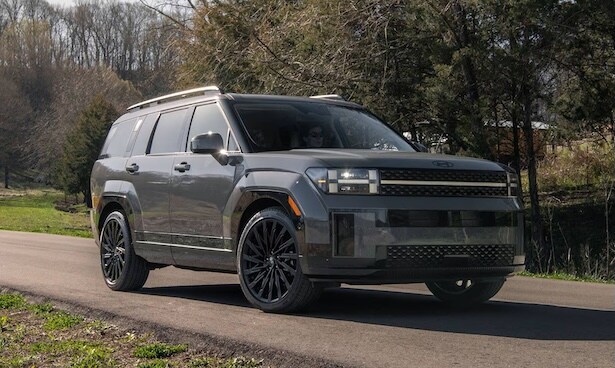
The 2026 Hyundai Santa Fe provides significantly more functional passenger room and cargo versatility than the 2026 Kia Sorento, making it the more accommodating three-row midsize SUV for growing households. While both vehicles offer standard three-row seating, the Santa Fe delivers superior legroom across all three rows, higher headroom, and a broader, more squared-off cargo floor that handles bulky items with ease.
Every inch counts when loading up children, sports equipment, and groceries. In the front row, the Santa Fe supplies 44.4 inches of legroom and 41.1 inches of headroom, compared to 41.4 inches of legroom and 40.3 inches of headroom in the Sorento. Second-row occupants in the Santa Fe enjoy 42.3 inches of legroom, while the third row provides 30.0 inches of legroom and 37.7 inches of headroom. The Sorento measures tighter in the back, offering 29.6 inches of third-row legroom and 36.8 inches of third-row headroom. For family weekend outings around the Scioto River parks in Dublin, that extra third-row breathing room keeps older kids and teenagers comfortable on longer drives.
Versatility also extends to how easily passengers can move throughout the cabin. Our team frequently walks buyers through the one-touch folding and sliding mechanisms on our showroom floor, where the Santa Fe impresses parents because the second-row seats tilt and slide forward smoothly even with an empty forward-facing child safety seat installed. To explore current factory promotions and purchase programs on our incoming lineup, browse current factory incentives on new Hyundai models before stopping by. When you are ready to test the seating arrangement in person, give our sales specialists a quick call or visit our showroom on Billingsley Road to sit in all three rows yourself.
How Does Starting MSRP and Trim Value Compare Between the Santa Fe and Sorento?
The 2026 Hyundai Santa Fe lineup begins at a base MSRP of $35,050 for the well-equipped SE 2.5 front-wheel-drive model, delivering standard turbocharged power and advanced convenience features that rival mid-tier trims on the Sorento. While the Kia Sorento advertises a slightly lower entry sticker price on its base LX trim, that model comes equipped with an entry-level, naturally aspirated engine that produces just 191 horsepower.
In contrast, every gas-powered Santa Fe comes standard with a robust 2.5L turbocharged four-cylinder powertrain producing 277 hp and 311 lb-ft of torque, linked to a responsive SHIFTRONIC transmission. Stepping through the Santa Fe lineup provides exceptional equipment jumps for the price:
- SE 2.5: Starting at $35,050 (or $36,850 with all-wheel drive), featuring standard 18-inch alloy wheels, a 12.3-inch center touchscreen display, and a hands-free smart liftgate.
- SEL 2.5: Starting at $37,590 (or $39,390 with all-wheel drive), adding H-Tex leatherette-trimmed seats, heated front seats, dual wireless device charging, and roof rails.
- XRT 2.5 AWD: Anchored at $42,040, bringing standard HTRAC All Wheel Drive, all-terrain tires, higher ground clearance, and an upgraded 4,500 pounds maximum towing capacity.
- Limited 2.5: Priced at $44,600 (or $46,400 with all-wheel drive), introducing 20-inch wheels, leather seating surfaces, ventilated front seats, and Remote Smart Parking Assist.
- Calligraphy 2.5: The flagship luxury trim starting at $47,600 (or $49,400 with all-wheel drive), treating occupants to quilted Nappa leather, dual captain's chairs, and dual glass sunroofs.
- Destination on all Santa Fe models is an additional $1,600.
Families cross-shopping these two SUVs often find that matching the Sorento to the Santa Fe's standard turbocharged performance requires upgrading to the Sorento EX or higher, which quickly erases any initial price discrepancy. If you are preparing to trade in your current vehicle to lower your monthly payments, our finance team makes trade appraisal seamless by valuing your trade-in online in minutes. We also stock an extensive variety of high-quality pre-owned options, so feel free to inspect our selection of pre-owned Hyundai vehicles if you are looking for exceptional capability across different model years.
Which SUV Offers More Cargo Space and Better Tailgate Utility?
With about 15 cubic feet behind the third row, roughly 41 behind the second, and nearly 80 with both rear rows folded, the 2026 Hyundai Santa Fe gives shoppers several useful cargo configurations. The Sorento trails behind with about 13 cubic feet behind its third row and a maximum capacity of about 75.5 cubic feet behind the front row.
Raw dimensions tell only part of the story; cargo loading geometry is where the Santa Fe truly outclasses its rival. Hyundai engineered the rear opening with an ultra-wide, terrace-style liftgate opening. By relocating the rear tailgate hydraulic struts to the outer edges of the body, the Santa Fe achieves an opening that is several inches wider than conventional midsize crossovers, including the Sorento. When you raise the standard hands-free smart liftgate, you are greeted by a flat sill and virtually vertical side walls that prevent luggage, sports coolers, and boxed furniture from catching on interior trim.
Small-item utility throughout the Santa Fe cabin is equally thoughtful:
- A dual-hinged center console armrest opens from both the front and rear, allowing second-row passengers to reach interior storage compartments effortlessly.
- A pass-through lower storage tray beneath the center console holds handbags, tablets, or small travel bags off the vehicle floor.
- A hidden exterior C-pillar grab handle supports your grip when stepping onto the rear tire to secure rooftop cargo carriers or bicycles.
- A bi-directional sliding storage drawer in the lower rear console gives second-row riders dedicated space for toys, charging cords, and snacks.
Whether loading strollers for everyday errands or packing tents and sleeping bags for outdoor excursions, the Santa Fe functions as an open-air staging platform. To take advantage of attractive purchase opportunities on our lot, review our featured new vehicle specials and get pre-approved quickly by applying for financing online from home.
Seating Comfort and Versatility: Are Heated and Ventilated Second-Row Seats Available?
Second-row outboard seat heating is available on both the Hyundai Santa Fe and Kia Sorento on higher trim levels, but neither midsize model offers ventilated second-row seats. The Santa Fe counters this segment limitation by providing superior second-row adjustability, ergonomic padding, and standard second-row window sunshades on upper grades to keep rear passengers cool and shielded from glare.
Seating layouts cater directly to your family's passenger preferences. The Santa Fe SE, SEL, and XRT trims feature a 60/40 split-folding second-row bench seat that accommodates up to seven passengers. On the Limited and Calligraphy trims, premium power-folding second-row captain's chairs become available or standard, configuring the SUV for six passengers with an open center aisle that grants effortless walk-through access to the third row.
Long-distance highway travel highlights the Santa Fe's relaxation engineering. On the Calligraphy trim, the driver's seat includes a power-deploying leg cushion extension and a one-touch relaxation function that tilts the seat back into an ergonomic resting posture during roadside stops. Second-row passengers in captain's-chair-equipped Santa Fe models enjoy power recline and tilt adjustments, enabling rear riders to find their preferred posture without manual levers. Both models provide retractable built-in rear door sunshades on high-tier trims, shielding infant car seats from afternoon sunlight.
Screen Technology and Audio: How Do the Infotainment Systems Differ?
The 2026 Hyundai Santa Fe standardizes a generous 12.3-inch touchscreen display on every single trim level, whereas the Sorento reserves its fully unified digital dash experience for pricier editions. Moving to the Santa Fe Limited or Calligraphy pairs that center display with a matching 12.3-inch digital instrument cluster, forming an expansive curved panoramic display under a single glass pane that delivers vehicle speed, navigation guidance, and safety alerts directly in your line of sight.
Wireless Apple CarPlay and Android Auto integration comes standard across the entire Santa Fe range, eliminating messy cables on the dashboard. Tech-forward drivers will appreciate modern hardware touches tailored for busy households:
- An available high-speed dual wireless smartphone charger on the center console powers two devices simultaneously at 15 watts.
- High-power USB-C ports rated up to 27 watts are located in all three rows, keeping phones, handheld games, and tablets fully charged.
- A glovebox-integrated UV-C sanitizing compartment on top trims helps disinfect smartphones, keys, and wallets using ultraviolet light.
- An available full-display digital rearview mirror provides an unobstructed camera feed of what is behind the vehicle even when cargo is stacked to the headliner.
Acoustic performance is equally refined. Music lovers can experience the optional 12-speaker Bose premium audio system, which features custom-tuned equalization, a dedicated center channel, and a deep-bass subwoofer that fills the cabin with concert-grade sound. While the Sorento also offers an optional Bose audio configuration on its top-tier SX Prestige, the Santa Fe combines its premium sound with standard acoustic-laminated front side glass that significantly reduces road and wind noise at highway speeds.
Which Model Provides Better Warranty Protection and Maintenance Perks?
While both Korean automakers provide identical factory warranty durations, the 2026 Hyundai Santa Fe delivers superior long-term ownership value thanks to Hyundai Complimentary Maintenance, a program Kia does not match. Both vehicles share a generous 10-Year / 100,000-Mile Powertrain Limited Warranty covering the engine and transmission, along with a 5-year / 60,000-mile new vehicle limited warranty.
The financial advantage shifts decisively toward the Santa Fe through standard factory care. Every new Santa Fe purchased at our dealership includes Hyundai Complimentary Maintenance for 3 years or 36,000 miles, whichever comes first. This program covers scheduled oil and filter changes, tire rotations, and multi-point inspections performed by factory-certified technicians using genuine parts.
Emergency travel protection is also comprehensive. Hyundai provides 5 years of roadside assistance with unlimited mileage, ensuring professional towing, lockout help, and flat-tire support are always accessible. In the event of a flat tire or mechanical issue anywhere on the road, you can connect directly with manufacturer-backed support by contacting Hyundai Roadside Assistance: 1-800-243-7766. To experience these ownership advantages in an ultra-efficient electrified package, check out our new Hyundai Santa Fe Hybrid inventory or explore our thoroughly vetted certified pre-owned Hyundai lineup for added peace of mind.
Practical Answers for Midsize Three-Row SUV Shoppers
Q: Does the 2026 Hyundai Santa Fe require premium fuel to achieve its rated horsepower?
The standard 2.5L turbocharged four-cylinder engine in the 2026 Hyundai Santa Fe is engineered to run on regular unleaded fuel. You achieve its full factory output of 277 hp and 311 lb-ft of torque without purchasing higher-octane gas. This keeps your routine fueling expenses lower compared to many luxury-brand turbocharged alternatives that demand premium gasoline at the pump.
Q: How does the Santa Fe all-wheel-drive system handle snowy winter commutes?
Hyundai's available HTRAC All Wheel Drive uses an electronic variable-torque-split clutch to actively distribute power between the front and rear axles based on wheel slippage and steering inputs. In wet slush or sub-freezing snow conditions, the system directs traction rearward to stabilize the vehicle before wheelspin occurs. The off-road-oriented XRT 2.5 AWD trim also includes dedicated multi-terrain control modes that calibrate throttle response and braking for deep snow and slippery surfaces.
Q: Can the third-row seats in the Santa Fe fold completely flat into the floor?
The 50/50-split third-row seats fold completely flat into the cargo floor with a single manual pull strap located on the seatback. When stowed, the seats create an unbroken, level loading surface flush with the rear sill. There are no awkward humps or gaps, allowing storage bins and luggage to slide smoothly across the floor without snagging.
Q: What is the real-world fuel economy difference between front-wheel drive and all-wheel drive on the Santa Fe?
The front-wheel-drive Santa Fe delivers an EPA-estimated 20 city / 29 hwy mpg with 24 mpg combined. Selecting all-wheel drive adjusts those estimates slightly to 20 city, 28 highway, and 23 combined mpg. For drivers seeking maximum range and fuel economy, the Santa Fe Hybrid produces 231 hp while achieving up to 36 mpg in mixed driving conditions.
Q: Does the Santa Fe offer built-in sunshades on the rear passenger doors?
Retractable manual sunshades are built into the rear passenger door panels on Santa Fe Limited and Calligraphy trims. These roller shades pull upward from within the door frame and hook into ceiling tabs, blocking harsh glare while allowing the rear power windows to be operated independently underneath.
Prices and MSRP referenced in this article are estimates for informational purposes only and do not constitute an offer to sell. See dealer for complete details. Fuel economy estimates shown may differ from official EPA ratings and should not be relied upon as a guarantee of actual vehicle performance.