
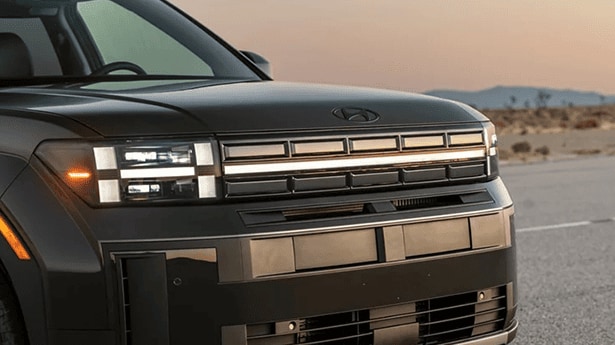
The Hyundai Tucson is a compact, two-row crossover seating five passengers, while the Hyundai Santa Fe is a midsize SUV offering three rows for up to seven people. Choosing between them comes down to size and passenger capability. Based on current lineup specifications, the Tucson delivers up to 38 mpg combined in hybrid models and up to 2,000 pounds of towing capacity. The larger Santa Fe provides up to 86 cubic feet of total cargo volume and hauls up to 4,500 pounds.
For drivers evaluating the 2026 Hyundai Tucson and 2026 Hyundai Santa Fe models, both crossovers carry over Hyundai's commitment to utility and advanced cabin technology. Anticipated updates for the 2026 model year build upon current structural strengths: the Tucson serves as an agile option for daily driving, whereas the Santa Fe caters to expanding household space requirements. If you are comparing both models in person, our showroom at 2441 Billingsley Rd in Columbus is conveniently located for side-by-side walkarounds. You can also give our team a quick call at (614) 782-1029 to check incoming model availability.
What Are the Size, Seating, and Cargo Space Differences Between the Tucson and Santa Fe?
With 86 cubic feet of cargo space and seating for up to seven, the 2026 Hyundai Santa Fe caters to larger families, while the Tucson’s 75 cubic feet and five seats suit smaller groups.
Inside the cabin, physical dimensions highlight clear functional distinctions. The Tucson measures roughly 182 inches in length, delivering about 39 cubic feet of storage behind the second row. That layout leaves generous legroom for five adults without sacrificing rear hatch room for athletic gear or groceries. By contrast, the Santa Fe measures about 190 inches long with a 111-inch wheelbase. With all three rows upright, the Santa Fe provides about 15 cubic feet of storage, expanding to about 41 cubic feet when the third row is folded flat into the floor.
For families in Dublin commuting along corporate corridors near the Scioto River, the Tucson's compact footprint fits easily into tight parking spaces while maintaining ample everyday utility. Meanwhile, buyers requiring maximum passenger versatility gain standard or available captain's chairs in the Santa Fe. If you are exploring previous model years to evaluate how cabin dimensions have evolved over time, you can browse our pre-owned vehicle selection online.
How Do Powertrains, Horsepower, and Towing Capacities Compare Between the Two SUVs?
Engine choices cater to different performance requirements. The standard Tucson pairs its 2.5L 4-cylinder engine with an 8-speed automatic transmission, while its hybrid variant generates 231 horsepower and achieves an EPA-estimated up to 38 mpg combined. A plug-in hybrid Tucson variant elevates output further to 261 horsepower. Drivers looking to haul small utility trailers, pop-up campers, or personal watercraft will find the Tucson's 2,000-pound tow rating fully capable for weekend recreation.
The Santa Fe delivers elevated pulling power for heavier loads. Its standard 2.5L Turbo 4-cylinder engine produces 311 lb-ft of torque, managing standard towing up to 3,500 pounds, while the off-road-oriented XRT trim increases trailering capacity to 4,500 pounds when properly equipped with trailer brakes. The Santa Fe Hybrid pairs a 1.6L Turbo 4-cylinder engine with an electric motor to yield 232 horsepower and up to 36 mpg combined. Both SUVs offer available HTRAC All-Wheel Drive for traction in Central Ohio winter weather. For local workers traveling between manufacturing facilities in Marysville, having reliable traction and responsive highway merging power makes long drives confident year-round. You can explore our current showroom lineup by viewing our new Hyundai inventory online.
What Advanced Safety Features Come Standard on the Tucson and Santa Fe?
Both the 2026 Hyundai Tucson and Santa Fe come standard with the Hyundai SmartSense safety suite, including Forward Collision-Avoidance Assist, Lane Keeping Assist, and Blind-Spot Collision-Avoidance Assist.
Active safety technology is comprehensive across both model lines. Standard equipment includes Driver Attention Warning, High Beam Assist, Lane Following Assist, and Rear Cross-Traffic Collision-Avoidance Assist. Upgrading to higher trim levels adds sophisticated options like Highway Driving Assist, Blind-Spot View Monitor, and Remote Smart Parking Assist 2.
Occupant protection is further reinforced by Safe Exit Warning and Rear Occupant Alert, helping safeguard children and pets when exiting the vehicle. Hyundai models have consistently earned top safety recognitions, including IIHS Top Safety Pick awards and NHTSA 5-Star Overall Safety Ratings on models tested in recent years. Furthermore, peace of mind comes standard with Hyundai's industry-leading coverage: a 10-Year / 100,000-Mile Powertrain Limited Warranty covers major components like the engine and transmission for the original owner. When you are ready to take the next step toward ownership, you can submit our online credit application to contact our team for current financing information.
Which Hyundai SUV Better Fits Your Daily Lifestyle and Family Needs?
Fuel economy and maneuverability make the Tucson a top choice for small households, while the Santa Fe’s flexible seating accommodates larger families.
Choosing the right crossover depends on how your household utilizes cabin space and cargo areas on a weekly basis. The Tucson serves as an efficient daily driver, providing nimble handling and reduced fuel consumption during mixed urban commutes. Its rear seat accommodates child safety seats effortlessly while maintaining substantial cargo volume behind the second row.
The Santa Fe caters to households with frequent carpooling demands or extra passengers. With second-row captain's chairs or bench configurations, getting kids and gear loaded is straightforward. When walking shoppers through both models on our showroom floor, parents usually compare second-row car-seat clearance and third-row access mechanisms before they ask about trim packages. When managing trade-ins for an upgrade to a larger model, At Great Lakes Hyundai ... the savings are SO good! Sell us your car! We need used cars! We will purchase your vehicle, even if you’re not buying a new one! Bring it in for an appraisal or get a Cash Offer in minutes using our partnership with Edmunds by starting with our trade-in valuation tool.
Common Questions About Choosing Between the Hyundai Tucson and Santa Fe
Q: Can the Hyundai Tucson haul a pop-up camper or small utility trailer for weekend trips?
Yes, equipped with a 2,000-pound maximum tow rating, the Tucson comfortably hauls light utility trailers, small teardrop campers, pop-up tent trailers, and personal watercraft. Owners planning regular towing should ensure proper hitch installation and verify total trailer weight, including gear and fluids, stays within the rated gross trailer weight limit.
Q: What is the payload capacity difference between the Tucson and Santa Fe?
Payload capacity for the Santa Fe generally ranges between 1,300 and 1,500 pounds depending on engine and drivetrain configuration. The Tucson features a payload rating typically between 1,100 and 1,250 pounds. This extra payload allowance gives the Santa Fe more capacity for carrying heavy cargo alongside a full load of passengers.
Q: Does the Santa Fe Hybrid require charging from a wall outlet?
No, the Santa Fe Hybrid is a traditional hybrid that recharges its battery automatically through regenerative braking and engine operation while driving. Drivers do not need a home charging station or 240-volt outlet. For buyers seeking electric-only driving range via plug-in charging, the Tucson Plug-In Hybrid offers plug-in functionality.
Q: What convenience tech features are exclusive to upper trims on the Santa Fe?
Upper Santa Fe trims offer premium tech features not found on standard compact models, including dual wireless smartphone charging pads, a UV-C sterilization compartment in the glove box, a 360-degree Surround View Monitor, and power-folding second-row seats. Top trims also feature a digital rearview camera mirror and a head-up display.
Q: What documentation should I prepare before applying for vehicle financing?
Preparing your driver's license, recent pay stubs or proof of income, proof of residence such as a utility bill, and current vehicle insurance information streamlines the credit approval process. Bringing trade-in title documents or lien payoff information also speeds up transaction processing at the dealership.
Prices and MSRP referenced in this article are estimates for informational purposes only and do not constitute an offer to sell. See dealer for complete details. Fuel economy estimates shown may differ from official EPA ratings and should not be relied upon as a guarantee of actual vehicle performance.