
Hyundai SmartSense manages heavy commute traffic through a network of radar sensors, front-facing cameras, and ultrasonic detectors that continuously monitor surrounding vehicles, lanes, and obstacles. The driver-assist safety suite coordinates Smart Cruise Control with Stop & Go, Lane Following Assist, and Forward Collision-Avoidance Assist to regulate vehicle speed, maintain safe following intervals, keep the vehicle centered in its lane, and apply automatic emergency braking when sudden stops occur.
Navigating dense morning or evening traffic requires constant vigilance. Hyundai driver-assist features act as a co-pilot, helping reduce driving fatigue during slow crawling or rapid speed shifts. In popular commuter vehicles like the 2026 Hyundai Elantra sedan or the 2026 Hyundai Tucson compact SUV, camera and radar sensors track movement several vehicles ahead. When speed drops suddenly, the system alerts the driver and modulates brake pressure to help prevent rear-end collisions.
Our sales team frequently walks commuters through these active safety suites on our test loop. When testing these features on local highway routes, drivers notice how smoothly Lane Following Assist identifies painted lane markers to keep the vehicle centered without harsh steering corrections. Combined with Driver Attention Warning, which monitors driving patterns for fatigue, Hyundai safety tech offers multi-layered protection for daily suburban travel.
Whether you are cross-shopping models or comparing safety packages, our inventory provides options equipped with advanced convenience tech. To test these driver-assist systems in person, visit our local showroom or give our sales team a quick call to set up an appointment.
How Does Hyundai SmartSense Assist With Stop-and-Go Traffic on I-71?
Hyundai SmartSense simplifies stop-and-go traffic on I-71 by pairing Smart Cruise Control with Stop & Go with active lane-centering systems. Radar sensors measure the exact distance and speed of the vehicle ahead, allowing your Hyundai to accelerate to your set speed when traffic clears or slow to a complete stop when vehicles ahead halt.
When traffic brought to a complete stop resumes within 3 seconds, Smart Cruise Control with Stop & Go automatically accelerates back to your designated speed and distance setting without driver intervention. If the full stop lasts longer than 3 seconds, the system prompts you with an alert; a light tap on the accelerator pedal or a quick toggle of the steering-wheel switch immediately re-engages automatic distance control.
This stop-and-go capability pairs with efficient powertrains across the Hyundai lineup. For example, the 2026 Hyundai Tucson Blue SE HEV AWD utilizes a 1.6L turbocharged hybrid engine producing 231 hp and 271 lb-ft of torque routed through a SHIFTRONIC® automatic transmission. Gasoline models like the Tucson SE AWD feature a 2.5L engine generating 187 hp and 178 lb-ft of torque, delivering steady power when accelerating back to highway speeds in Columbus traffic.
Drivers looking for practical daily commuters can explore our pre-owned vehicle selection to find models equipped with adaptive cruise control and lane-keeping technologies that take the friction out of peak travel hours.
What Is Hyundai Highway Driving Assist II and Which Models Offer It?
Highway Driving Assist II (HDA II) is an advanced semi-autonomous driving system that combines Smart Cruise Control with Stop & Go, Lane Following Assist, and highway curve control with active lane-change capability. Using radar and camera sensors, HDA II maintains set highway speeds, keeps the vehicle centered, and performs automated lane changes when the driver activates the turn signal.
Standard Highway Driving Assist keeps your vehicle centered in its lane and maintains a set gap behind traffic. HDA II enhances this experience by adding side radar sensors that monitor surrounding lanes. When you signal a lane change on a compatible highway, HDA II assesses traffic density, determines when a gap is available, and gently steers the vehicle into the adjacent lane.
HDA II delivers refined performance in tight highway traffic:
- Early Lane-Cutter Detection: Side sensors detect vehicles merging abruptly into your lane, prompting gentle speed adjustments to restore safe following distance.
- Active Offset Steering: When passing semi-trucks or wide loads, the system slightly offsets your vehicle within its lane to maintain a comfortable buffer.
- Navigation-Based Curve Control: Uses GPS data to reduce speed automatically when approaching sharp highway curves.
HDA II is available on upper trim levels of key models, including the 2026 Hyundai Santa Fe Calligraphy 2.5 AWD, Palisade, Ioniq 5, and Ioniq 6. Browse our new Hyundai inventory to find models with HDA II, or look through our certified pre-owned options to find tech-rich trims covered by factory warranty protections.
How Do Hyundai Blind-Spot Features Assist During Dense Highway Merging?
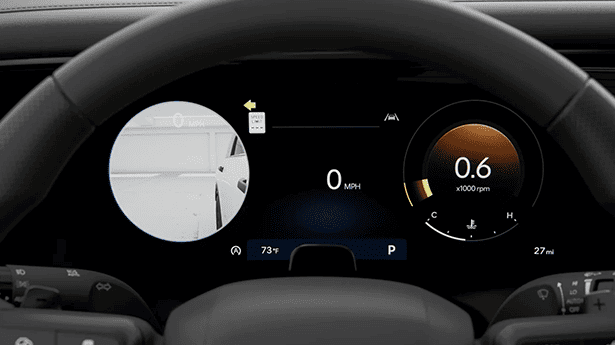
Hyundai blind-spot safety systems protect drivers during dense highway merging by providing real-time visual camera feeds and active steering or braking assistance. Blind-Spot View Monitor displays a live video feed of your blind spot directly in the digital instrument cluster when a turn signal is engaged, while Blind-Spot Collision-Avoidance Assist applies outer wheel braking if you attempt to change lanes into an occupied space.
Standard blind-spot warnings rely on side-mirror icons and warning chimes. Blind-Spot View Monitor goes further by giving you a clear view of approaching traffic, helping eliminate blind spots caused by vehicle pillars or cargo.
The 2026 Hyundai Tucson provides high visibility and functional cabin proportions across all configurations:
- Seating & Interior Room: Comfortable 5-passenger seating with supportive seating geometry for long commutes.
- Cargo Capacity: Generous about 39 cu ft of rear cargo volume in gas and HEV trims, and about 32 cu ft in PHEV models like the Tucson Limited PHEV AWD.
- Weight & Utility: Curb weights ranging from 3,572 lbs on SE AWD to 3,920 lbs on Limited HEV AWD models, with towing capacities up to 2,750 lbs on 2.5L gas models or 2,000 lbs on hybrid configurations.
Corporate commuters traveling along busy corridors around Dublin value these visual and active checks when changing lanes near tight exit ramps. If you are planning an upgrade to a tech-focused vehicle, you can value your trade-in online to see what your current vehicle is worth toward a new Hyundai.
How Does Forward Collision-Avoidance Assist Protect Congested Intersections?
Forward Collision-Avoidance Assist (FCA) guards against intersection accidents by combining front-facing radar and optical cameras to track cars, cyclists, and pedestrians. When a potential collision is detected, FCA issues visual and audible alerts, automatically applying Emergency Braking if the driver does not react in time.
Navigating multi-lane urban intersections during peak rush hour brings unpredictable hazards. Enhanced versions of FCA feature Junction Turning technology, which specifically targets left-turn risks. When turning left across oncoming traffic, the system monitors approaching lanes and applies emergency braking if an oncoming vehicle poses a collision threat.
FCA pedestrian detection systems operate during day and night hours, identifying foot traffic near crosswalks and bus stops. Ultrasonic sensors scan roadside perimeters to react to sudden pedestrian movements before human reaction time allows.
Upgrading to a vehicle equipped with Forward Collision-Avoidance Assist with Junction Turning provides peace of mind for family drivers. Our finance specialists can help you submit a credit application online to explore current financing options.
Frequently Asked Questions About Hyundai Rush-Hour Safety Features
Q: Does Smart Cruise Control with Stop & Go require driver input after stopping?
If a traffic stop lasts fewer than 3 seconds, Smart Cruise Control with Stop & Go automatically resumes acceleration as traffic moves. For stops exceeding 3 seconds, drivers simply tap the accelerator pedal or press the steering-wheel toggle switch to resume automated distance tracking.
Q: How does Highway Driving Assist respond when another car cuts into your lane unexpectedly?
Highway Driving Assist utilizes front-facing radar and side monitoring sensors to detect vehicles cutting in early. Rather than applying sudden emergency braking, the system smoothly modulates throttle and brake pressure to restore the pre-set following distance safely.
Q: Can Hyundai SmartSense detect pedestrians crossing busy city streets in low-light conditions?
Yes, Forward Collision-Avoidance Assist with Pedestrian Detection combines optical camera resolution with radar sensing to identify pedestrians and cyclists in reduced-visibility conditions, warning the driver and initiating active braking when necessary.
Q: What is the main operational difference between Blind-Spot View Monitor and Blind-Spot Collision-Avoidance Assist?
Blind-Spot View Monitor is a visual convenience feature that projects a live video stream of your blind spot onto the digital gauge cluster when signaling. Blind-Spot Collision-Avoidance Assist is an active safety system that applies corrective braking to individual wheels to keep the vehicle in its lane if a collision threat is detected.
Q: Which Hyundai SUVs feature standard active lane-centering systems for heavy traffic?
Models including the 2026 Hyundai Tucson, 2026 Hyundai Santa Fe, Kona, and Palisade include Lane Following Assist as standard equipment, providing continuous steering guidance to keep the vehicle centered in its lane.
Prices and MSRP referenced in this article are estimates for informational purposes only and do not constitute an offer to sell. See dealer for complete details. Fuel economy estimates shown may differ from official EPA ratings and should not be relied upon as a guarantee of actual vehicle performance.